Grown On Site
The Kayinja banana — a Slow Food Presidium variety — and our pineapples are grown on our own land, organically, under an agroforestry and regenerative system. Everything we pour begins in our soil.
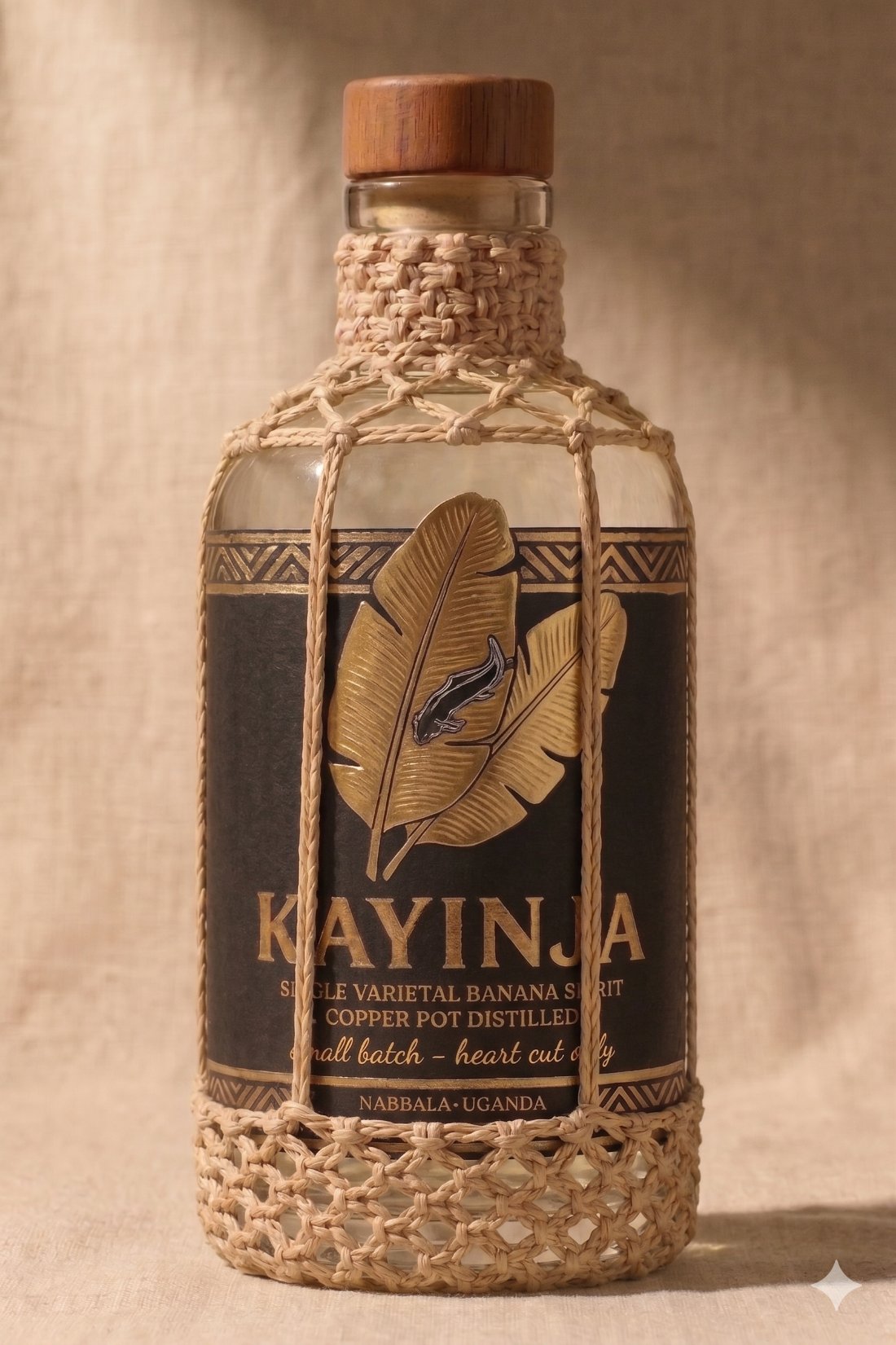
See the farmA single-varietal eau de vie distilled from the Kayinja banana — a Slow Food Presidium variety grown on our own land in Mukono. Copper pot-distilled, heart cut only, bottled at 42.5%. Made by two gastronomes trying to hold the taste of Uganda in a glass.
We grow the fruit, distil it ourselves, and feed everything that's left back into the land and the village around it. A small estate in Buganda, run as a closed circle.
The Kayinja banana — a Slow Food Presidium variety — and our pineapples are grown on our own land, organically, under an agroforestry and regenerative system. Everything we pour begins in our soil.
See the farmThe Kayinja banana eau de vie, copper pot-distilled and heart cut only at 42.5%, and a pineapple mistelle at 21%, rested in local clay pots sealed with beeswax. Small batches only.
Meet the bottlesSpent fruit and organic waste become protein for the community — goats, ducks and pigs. Five per cent of profit funds Nabbale Junior School and local education. A closed loop, on purpose.
How we workOne distilled, one fortified. Both made from a single fruit, grown a short walk from the still, and finished entirely by hand.
A single-varietal banana eau de vie, distilled only from the Kayinja banana — the dense, sugar-heavy fruit that Buganda has fermented into tonto and waragi for generations.
A fortified pineapple wine, made by stopping fresh estate-grown pineapple juice with our own Kayinja spirit — sweet, golden, and unhurried.
A banana grove, a pineapple hillside, a copper still and a yard full of animals — laid out so that what leaves one part of the farm feeds another. Everything in the bottle is grown within walking distance of the still.
The Kayinja banana — Buganda's traditional brewing variety and a Slow Food Presidium — grown organically under shade trees, dense, tannic and sugar-heavy.
Pineapples planted in tight rows on the south-facing slope. Hand-weeded, slow-grown, picked only when the crown gives way.
An agroforestry and regenerative system — no synthetic inputs, composted ferment returned to the ground, trees holding the red Mukono earth in place.
Goats, ducks and pigs raised on the organic waste from distilling — turning what's left into protein for the community. Nothing leaves the farm as rubbish.
Ducks pick through the orchard. Goats and pigs work the margins. There is no electric fence, and the gate is usually open.
We did not want to invent a flavour. We wanted to bottle one that was already here — the banana our grandparents brewed, distilled with patience and nothing else.Nico Nsubuga de Zan-ZakCo-founder · Gastronome
We host small farm visits by appointment — a walk through the grove, a look at the still, a glass of whichever bottle is open. Tea throughout.
Plan a Visit